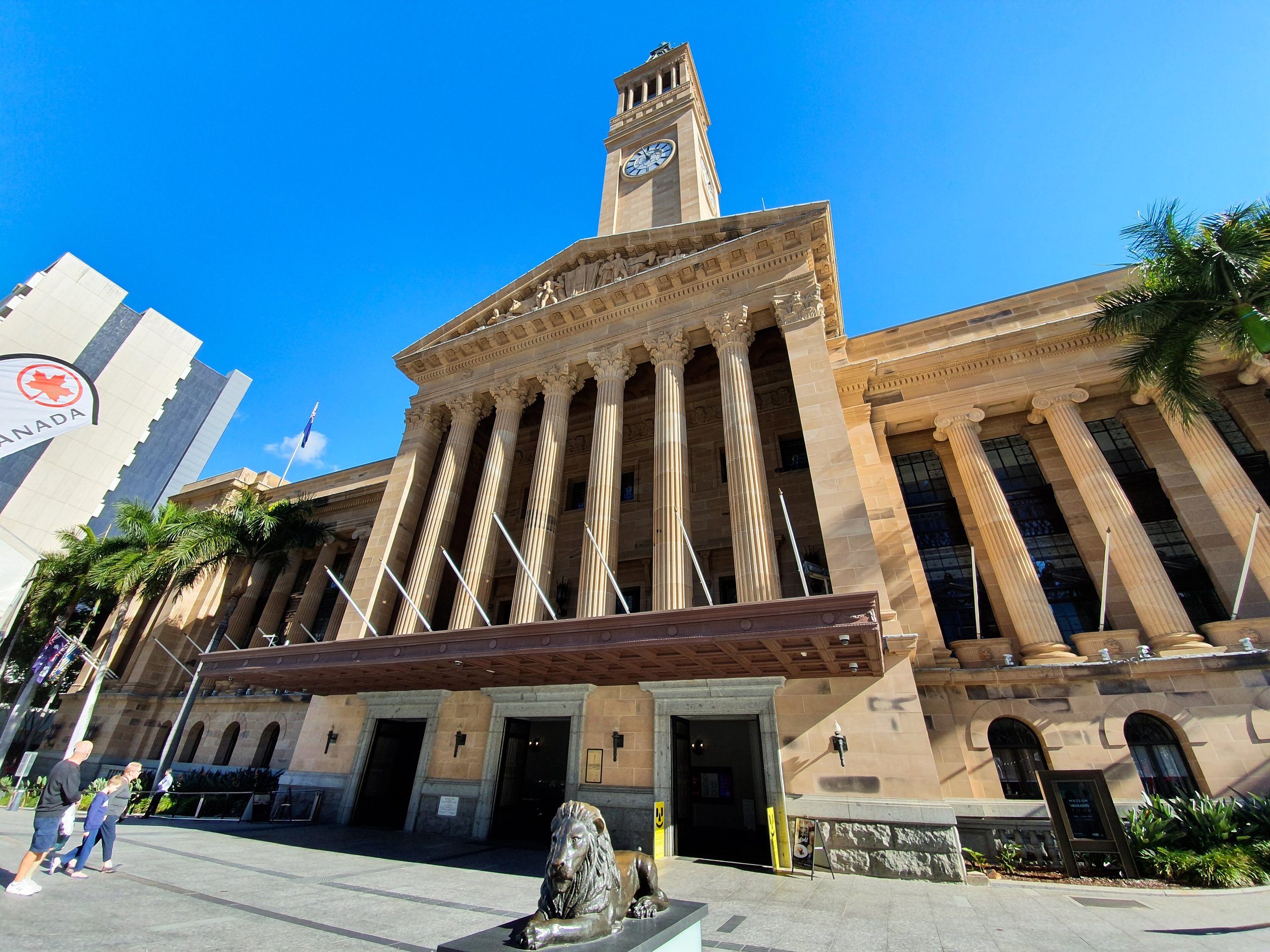
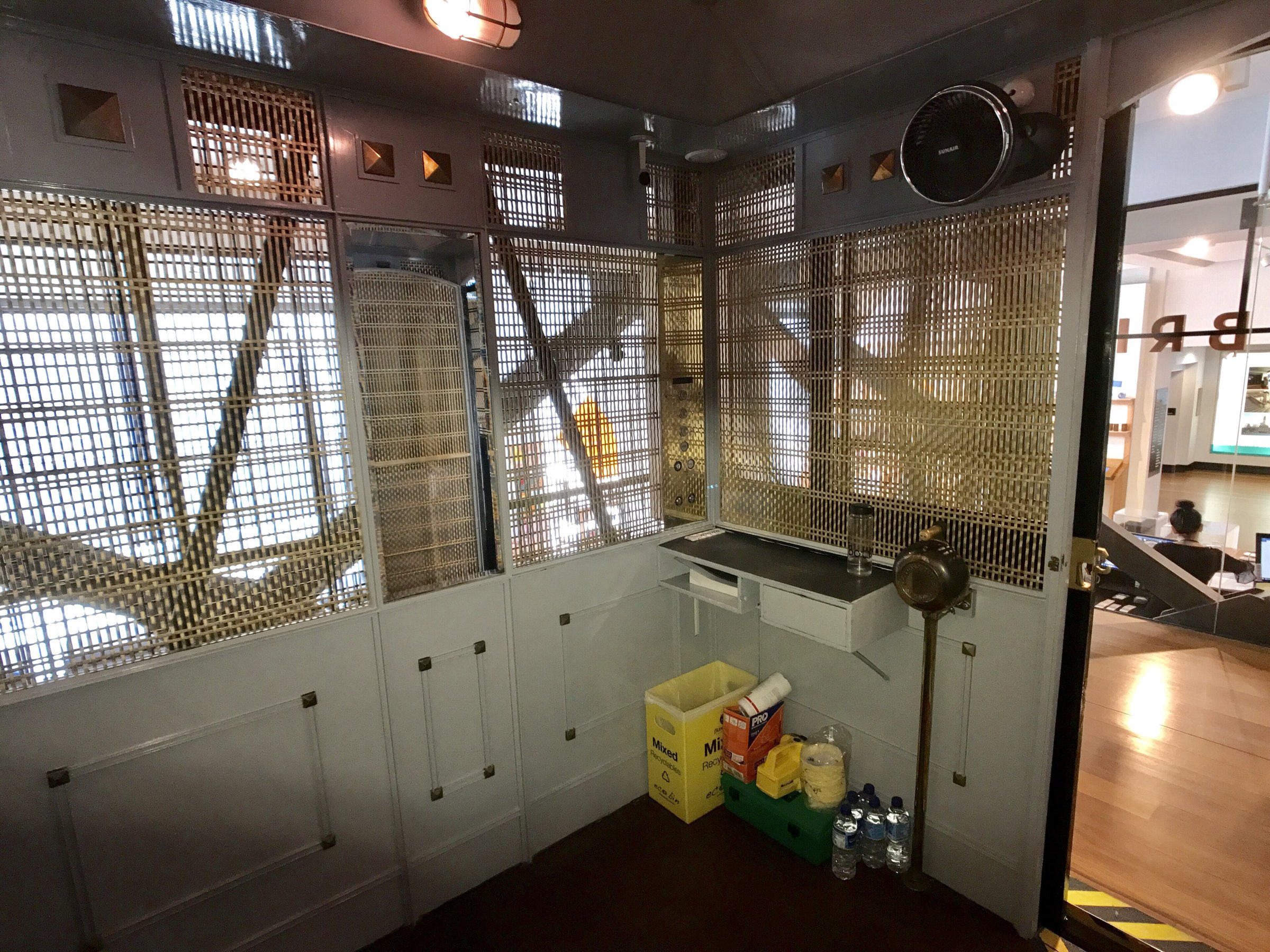
Brisbane City Hall is a sandstone civic landmark on King George Square in the Brisbane CBD, open every day with free clock tower tours, free guided tours of the building and the Museum of Brisbane on Level 3. The clock tower is about 90 metres tall, and the tour takes one of Brisbane’s oldest working cage lifts up to an observation platform with a 360 degree view of the city.
It was built between 1920 and 1930 as the home of the new Brisbane City Council, and it is still a working civic building: it is home to the Lord Mayor and council meets in the Council Chambers.
Clock tower tours at Brisbane City Hall
The clock tower tour is the main reason most people come. It is free, but you must book a ticket for everyone in your group, children and carers included. Tours run every 15 minutes from 10.15 am to 4.45 pm daily, last about 15 minutes and take up to seven people. Meet at the Museum of Brisbane reception on Level 3 and arrive 15 minutes before your time.
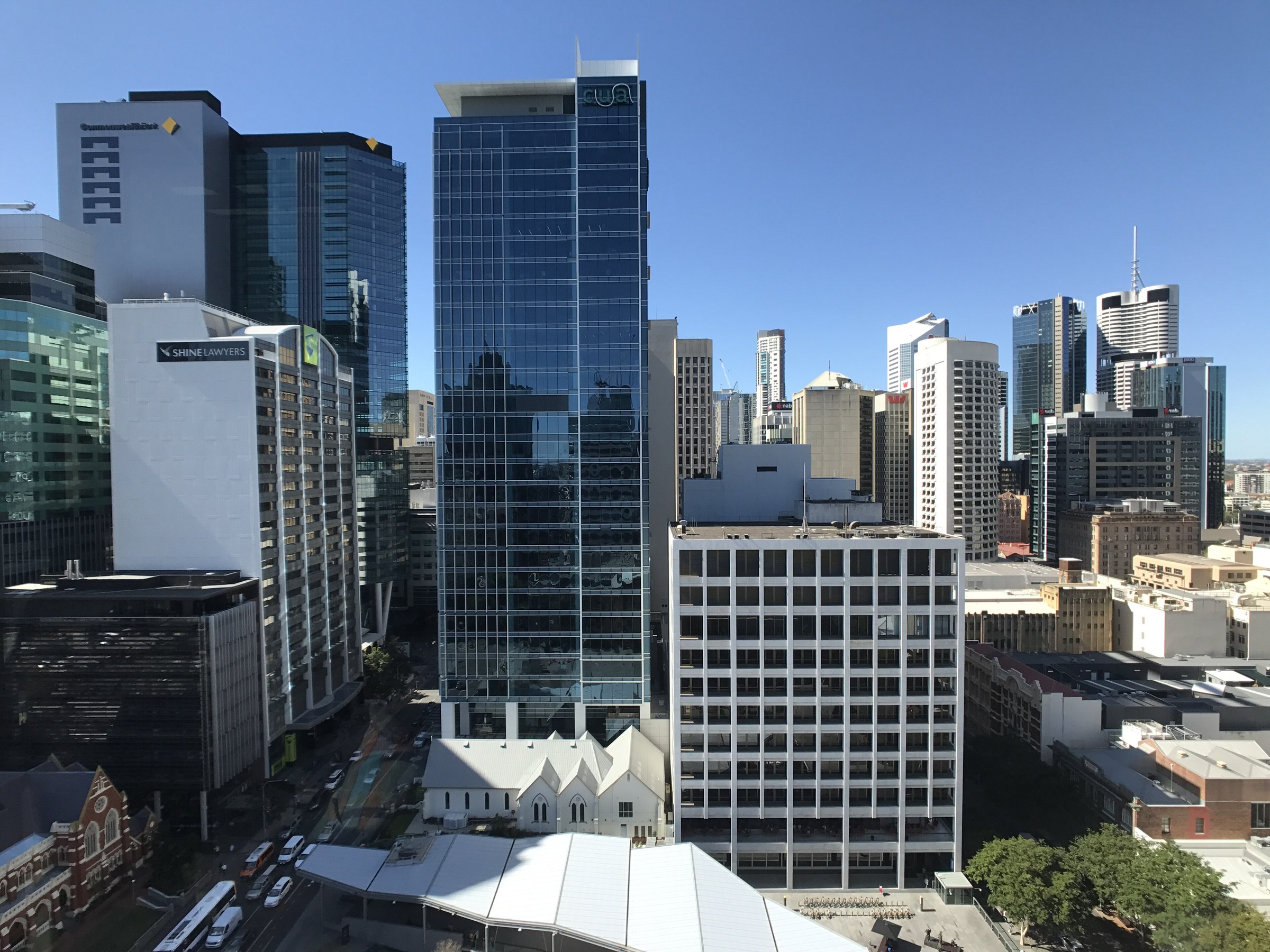
You ride the cage lift up, get a look behind the clock faces and finish on the observation platform, 76 metres up, for a 360 degree view over the CBD. You may catch a glimpse of the bells on the way.
Rules and access for the clock tower tour
- The tour is not wheelchair accessible and is not suitable for mobility aids. It includes 36 steps, and if the lift is out of action you would have to climb down 216 steps.
- The lift and tower are not air-conditioned (fans are provided), and tours can be cancelled above 36 degrees.
- No food or drink, and no backpacks, large bags or helmets; use the lockers on Level 3. Children 12 and under must be supervised.
City Hall tours and the Main Auditorium
The free Brisbane City Hall Tour runs for 45 minutes and starts in the King George Square foyer on the ground floor. It leaves at 10.30 am and 11.30 am every day, and at 1.30 pm from Friday to Sunday. Groups are limited to 20 people, so book online or call (07) 3339 0800. The tour is wheelchair accessible but includes some staircases.
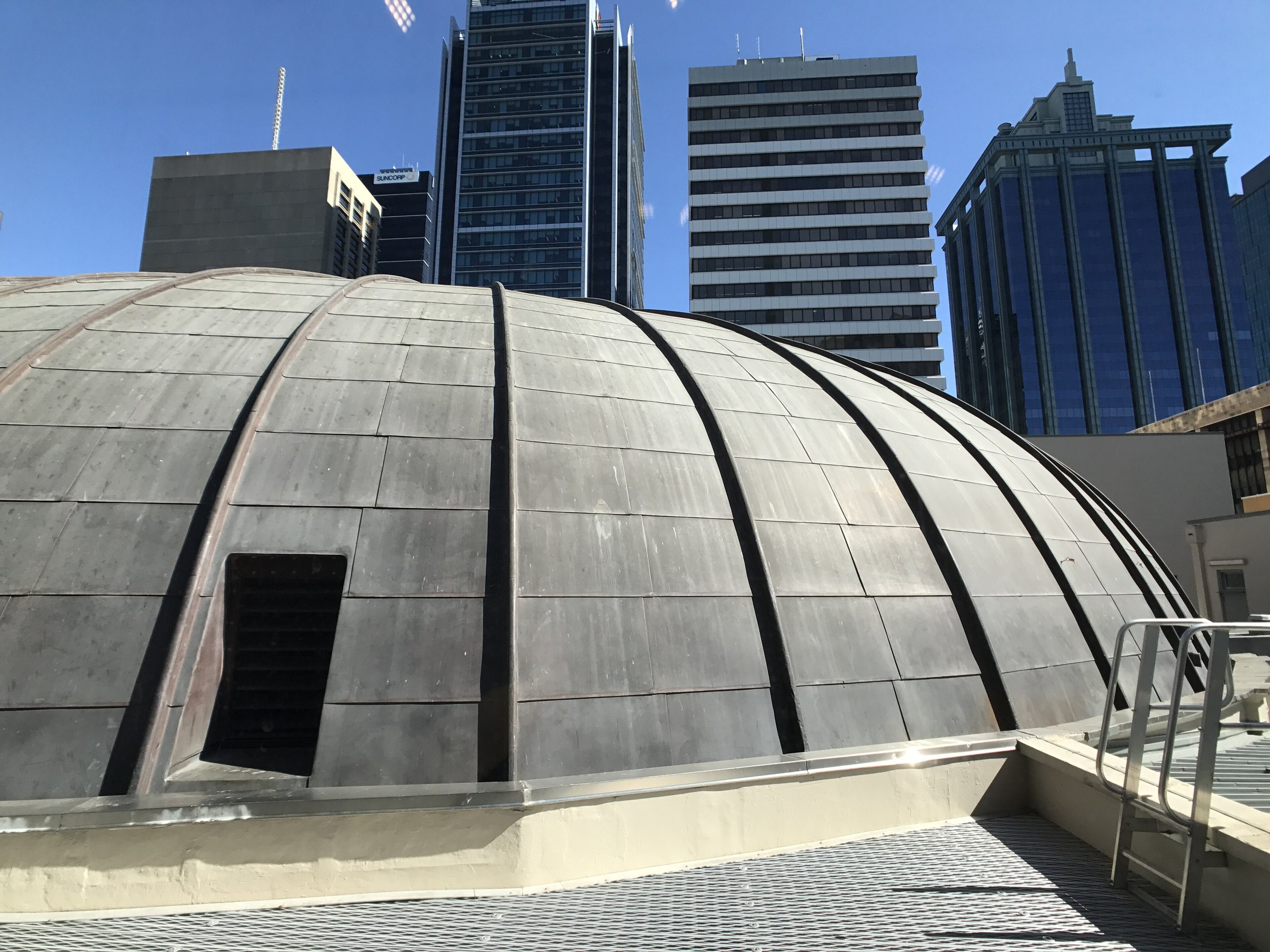
The tour takes in the marble foyer, the stained-glass windows, the mosaic tile floors and the Main Auditorium. The auditorium is modelled on the Pantheon in Rome, and its copper dome is 31 metres across and described as the biggest in Australia. The dome sits on a brick base with no columns in the way, and you can see it from Level 3. The Father Henry Willis organ in the auditorium has nearly 4,400 pipes, and the Museum lists a separate free organ tour, so check its website for dates.
City Hall is a working building, so some rooms are closed at times. Council meets in the Council Chambers on Tuesdays (except during recess), and anyone can watch from the public gallery.
Museum of Brisbane at City Hall
The Museum of Brisbane fills Level 3. Entry is free and it is open from 10 am to 5 pm every day. Come in through the King George Square foyer, turn right and take the lifts (there are no stairs to it).
Exhibitions change, so check the Museum’s visit page for what is on.
History of Brisbane City Hall
Choosing the site, 1914 to 1919
The new hall replaced the old town hall on Queen Street. In 1914 Mayor Charles Jenkinson settled on Albert Square, now King George Square, as the site. The Governor of Queensland laid the first foundation stone there in February 1917, before any design existed. The architects were T. R. Hall and G. G. Prentice, and council approved their design in 1919.
The City of Brisbane Act of 1924 had meanwhile created one council for Brisbane, with William Jolly as its first Lord Mayor.
Building it, 1920 to 1930
The Prince of Wales, the future Edward VIII, laid the second foundation stone on 29 July 1920. It is granite from Enoggera, and Mayor James Maxwell stood beside him for the ceremony. Construction took about ten years and cost about 980,000 pounds, and it was the first major Australian building with a concrete column and beam frame.
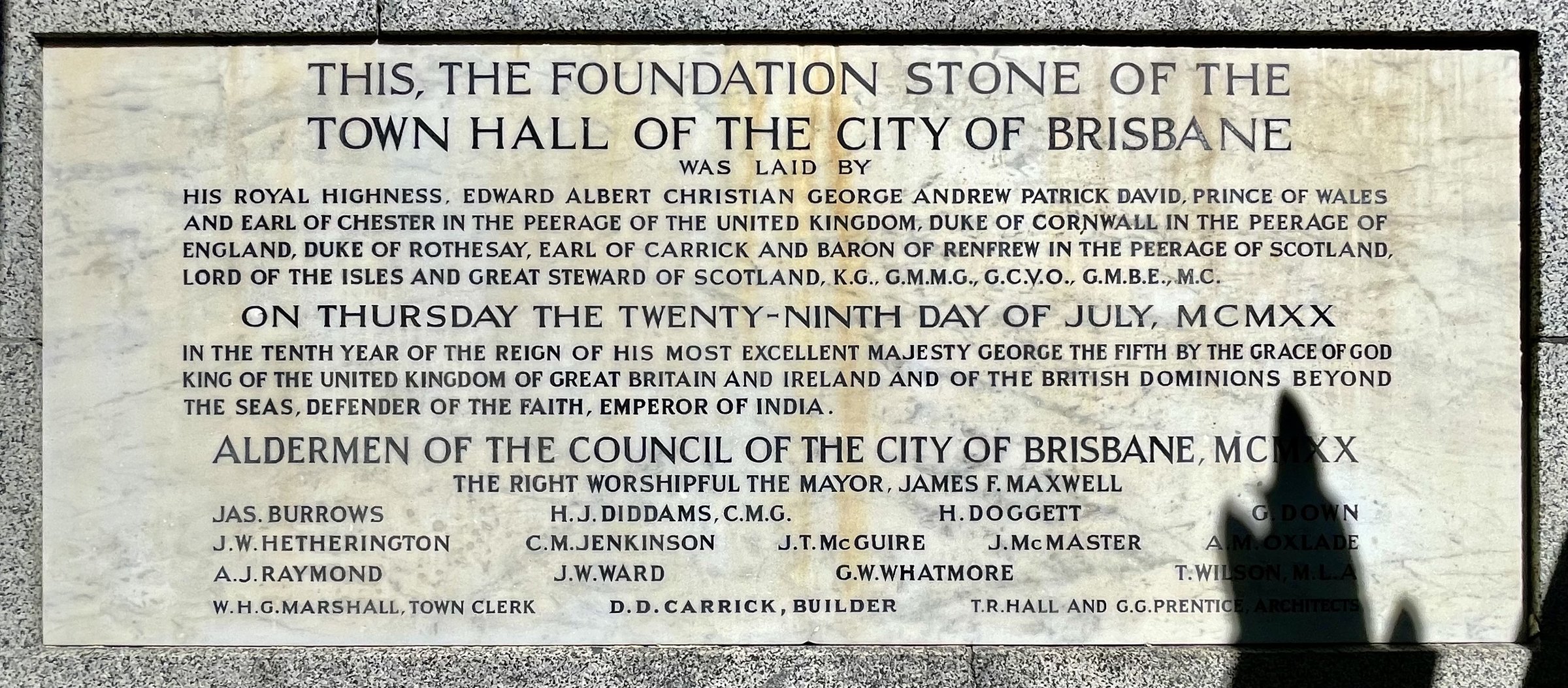
Council offices opened on 3 January 1928. The Governor, Sir John Goodwin, formally opened the building on 8 April 1930, the same day the rebuilt organ gave its first recital in the new hall.
The design
Hall and Prentice designed City Hall in an academic classical style with art deco touches, such as the geometric patterns and the black and white mosaic floors. The front has Corinthian columns nearly 14 metres high. The sandstone came from the Helidon district, about 95 km from the city, and inside there is Queensland maple and silky oak, with marble from Italy, Belgium and Orange in New South Wales.
Brisbane sculptor Daphne Mayo carved the stone relief above the entrance portico, which depicts the settlement of Queensland. It was completed in 1930.
The clock tower and its bells
Council gives the tower as 92 metres high, with the observation platform at 76 metres, and the Museum of Brisbane measures it at 87 metres above ground. Either way it made City Hall Brisbane’s tallest structure until the 1960s. When it was built the clock was Australia’s largest public clock: its face is almost 5 metres across and the minute hands are 3 metres long. Five bells made by the Taylor Bell Foundry in Loughborough, England, play the Westminster chimes every quarter hour. The design is said to be inspired by St Mark’s Campanile in Venice, and a red beacon at the top once warned aircraft.
The Willis organ
The organ is older than the building. Henry Willis and Sons of London built it in 1891 and 1892 for the Exhibition Building at Bowen Park, where it was first played in December 1892. It was rebuilt and enlarged for City Hall from 1927 to 1929. After a restoration by Pierce Pipe Organs that began in 2010, it reopened with a concert on 10 August 2014.
King George Square and the lions
The square in front of the hall was once Albert Street itself, and it was widened and renamed in tribute to King George V after his death in 1936. A Commonwealth competition chose the memorial, designed by Perth architect Reginald Summerhayes and sculptor Edward Kohler. It was unveiled in 1938, with an equestrian statue of the king and the two bronze lions you still see by the entrance. The statues were moved in the late 1960s to make way for a car park, and the lions are back at the entrance.
City Hall at war
In 1940 and 1941 City Hall was Brisbane’s civil defence headquarters, and it later held war bond rallies and receptions for visiting dignitaries. In 1942 it opened a childcare centre for war workers. The building also holds a World War II Signature Wall, a memorial of soldiers’ signatures. The Australian War Memorial’s Places of Pride listing says it is closed to general access, but that viewing can be arranged by booking a City Hall Tour.
Restoration and heritage listing
City Hall has been on the Queensland Heritage Register since 1992. Between 2010 and 2013 it had a restoration costing about $215 million, carried out by Tanner GHD, and it reopened on 6 April 2013.
Cafes, toilets and facilities
- Cafes: The Shingle Inn is on the ground floor, open 9 am to 4 pm daily. Marhaba Cafe is in the basement (enter from Adelaide Street) and is open 7 am to 3 pm Monday to Friday.
- Toilets: Accessible toilets are on the ground floor and on Level 3 at the Museum, with ambulant toilets on the ground floor and Levels 1 to 3. A Changing Places toilet is on the ground floor.
- Wheelchair loans: The Mobility Centre on the ground floor lends wheelchairs and wheeled walkers, free of charge for Museum visits. It is open Monday to Friday 8 am to 5 pm and Saturday and Sunday 9 am to 5 pm; ring 0457 068 055 to book.
Planning your visit
- Hours: City Hall is open Monday to Friday 8 am to 5 pm, and Saturday, Sunday and public holidays 9 am to 5 pm. It is closed on Good Friday, Christmas Day, Boxing Day and New Year’s Day, and opens only in the afternoon on Anzac Day.
- How long: Allow about 30 minutes for the clock tower tour, 45 minutes for the City Hall tour and as long as you like in the Museum. All three fit in about two hours.
- Cost: The Museum and both tours are free. Parking is the main cost.
- Best time: A clear day for the tower view; plan the rest around the City Hall tour times.
- Accessibility: The building has a ramp from King George Square, lifts, braille signs and audio loops. The clock tower tour is not accessible.
- Dogs: Guide dogs and assistance dogs are welcome at the Museum, and can join the clock tower tour with their own booked ticket.
Getting there and parking
City Hall is in the middle of the CBD, with its main entrance on King George Square between Adelaide and Ann streets. By train, Central and Roma Street stations are each about a 10 minute walk. Many buses stop on Adelaide Street and Ann Street and at the King George Square bus terminal, and City Hall is a short walk from the ferry terminals. Plan your trip with the Translink Journey Planner or call 13 12 30. For the river ferries, see the guide to Brisbane’s cross river ferries.
Street parking in the CBD is limited. The closest option is the undercover King George Square Car Park, run by council, with entry at 100 Adelaide Street and an entry and exit at 87 Roma Street. It has a height limit of 1.93 metres. Weekday parking is free for the first 15 minutes, then about $24 for up to an hour and $49 for the day. On weekends it is $10 for the first three hours and $20 at most. Council’s Wickham Terrace Car Park (136 Wickham Terrace, about 700 m away) is open 24 hours and charges a flat $6 at weekends. Check the council car parks page for current hours and prices.
There is no coach park. Coaches can drop off briefly at the Ann Street entrance, and long-term coach parking is at Roma Street Parkland.
The official pages are council’s visiting City Hall page and the Museum of Brisbane, which takes the tour bookings. Details can change, so check before you go.
Nearby
- Roma Street Parkland – a free city garden park a short walk from City Hall.
- Brisbane City Botanic Gardens – riverside heritage gardens that council puts a 10 to 15 minute walk from the city centre.
- The Old Windmill, Brisbane – the windmill tower on Wickham Terrace, built by convicts in the late 1820s.
- South Bank Parklands – a free riverside park across the river.
- Story Bridge – another Brisbane landmark worth seeing up close.
- Markets in Brisbane – for a market stop on the same day.
Browse more history and landmarks and museums.
Quick answers
Is Brisbane City Hall free to visit?
Yes for the Museum of Brisbane, the City Hall tours and the clock tower tours, but the tours need a booking. Parking nearby is paid.
What time does Brisbane City Hall open?
City Hall is open Monday to Friday 8 am to 5 pm, and Saturday, Sunday and public holidays 9 am to 5 pm. The Museum of Brisbane is open 10 am to 5 pm daily.
Can you go up the Brisbane City Hall clock tower?
Yes, on a free guided tour. Tours run every 15 minutes from 10.15 am to 4.45 pm, take up to seven people and must be booked for everyone, children included.
How tall is the Brisbane City Hall clock tower?
Council gives the tower as 92 metres high, with the observation platform at 76 metres. The Museum of Brisbane measures it at 87 metres above ground.
When was Brisbane City Hall built and who designed it?
Construction ran from 1920 to 1930. Council offices opened in January 1928 and the building was formally opened on 8 April 1930. Brisbane architects Hall and Prentice designed it.
Is Brisbane City Hall wheelchair accessible?
Yes, the building has ramp access, lifts and accessible toilets, and the City Hall tour is wheelchair accessible. The clock tower tour is not.



0 Comments